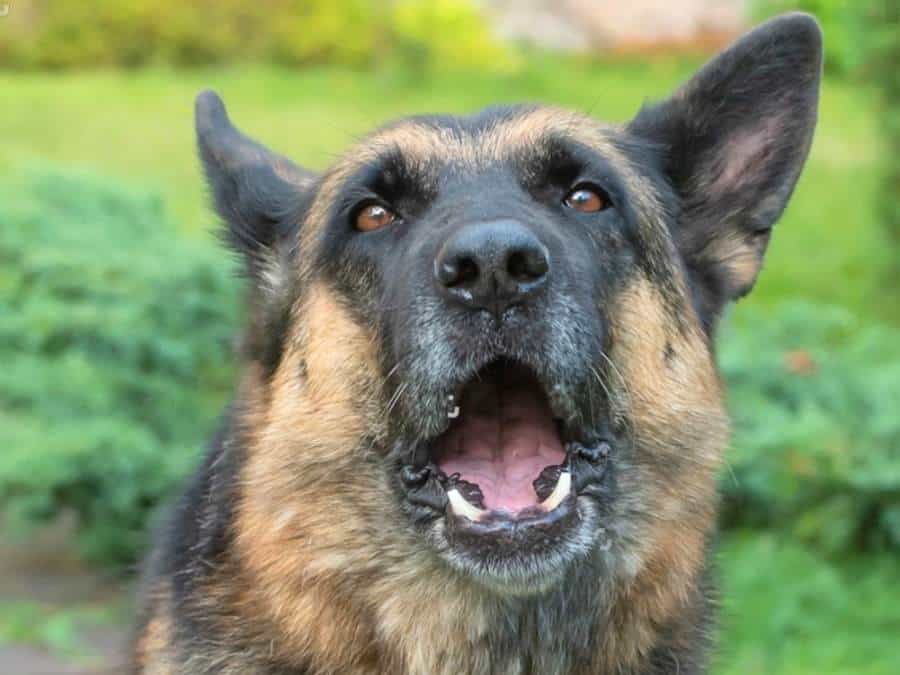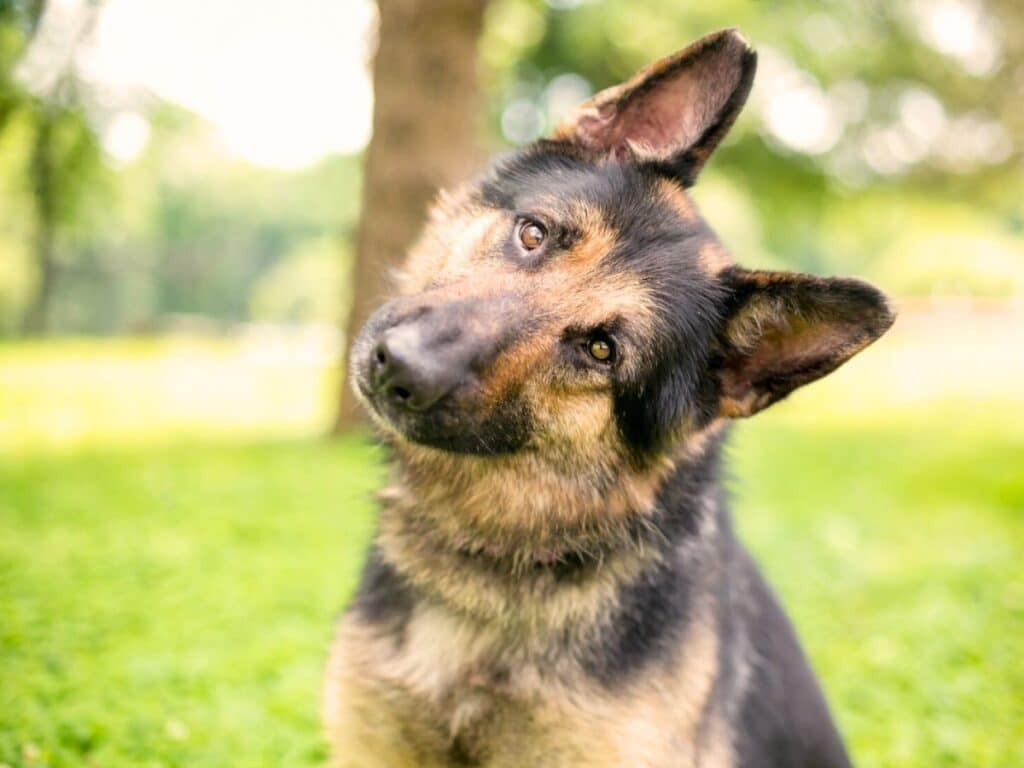

There’s a moment — usually somewhere around week two of having a German Shepherd puppy — when the excitement starts mixing with a little bit of panic.
The puppy you brought home is already smarter than you expected. He figured out how to open the pantry. She’s decided the couch belongs to her and will argue the point with conviction. He’s biting your ankles every time you walk past, and you’re starting to wonder if this is normal or if you accidentally adopted a small furry shark.
This post isn’t about making you feel bad for things you’ve already done. It’s about giving you a clear-eyed look at the ten most common and most expensive mistakes new German Shepherd owners make, why they happen, and exactly what you can do differently starting today.
Let’s get into it.
1. Letting the Puppy “Be a Puppy” for Too Long Before Starting Training
This is probably the mistake I see most often, and it comes from a completely understandable place. New owners bring home this fluffy, wiggly, irresistible little creature and think, he’s so young — let him just be a puppy for now. We’ll start training when he’s older.
I get it. It feels harsh to structure a ten-week-old puppy. It feels like you’re stealing his childhood.
But here’s what’s actually happening during those early weeks: your German Shepherd puppy is learning constantly, whether you’re teaching him or not. Every interaction is training. Every time he jumps on a guest and gets laughed at, he learns jumping works.
Every time he barks at the back door and you let him in, he learns barking is how you communicate. Every time he nips your hand during play and you keep playing, he learns that biting doesn’t stop the fun.
German Shepherds are among the most intelligent dog breeds on the planet, and that intelligence comes online early. The window between 8 and 16 weeks is often called the “critical socialization period” — but it’s also the most important window for establishing patterns of behavior, communication, and leadership. What you allow in those weeks tends to stick.
Why it becomes costly: A German Shepherd who doesn’t learn basic structure and expectations as a puppy doesn’t stay small and manageable.
By six months, you’re dealing with a 50-pound adolescent who has no framework for what “no” means, who has never had to wait or defer, and who has been accidentally rewarded for all the wrong behaviors. That’s when owners describe feeling like their dog is “uncontrollable” — when really, the dog was never given the tools to succeed.
What to do instead: Start the day you bring your puppy home. I don’t mean harsh corrections or military-style obedience. I mean simple, consistent communication.
Sit before meals. Four paws on the floor for affection. Leash manners start on the first walk, even if it’s just to the end of the driveway. Crate training begins on night one. You are building a language with your dog, and the earlier you start, the more fluent you both become.
A tired eight-week-old will learn “sit” in a single session. Make the sessions short — five minutes, a few times a day — make them fun, and be consistent. That’s it. You’re not ruining his puppyhood. You’re setting him up to be a dog you can trust.
Related: The Best German Shepherd Puppy Schedule by Age (Daily Routine Guide)
2. Skipping or Rushing Socialization
Raise your hand if you’ve ever heard someone say, “My German Shepherd is protective — that’s the breed.” And it’s true, German Shepherds are naturally watchful and alert. But there’s a line between a dog who is calm and confident and simply notices when something is off, and a dog who is reactive, anxious, or aggressive because the world feels threatening to him.
That line is almost always drawn during the socialization window.
I’ve watched owners avoid taking their puppies out until they were “fully vaccinated,” keeping them home and away from the world for the first four or five months.
By the time those dogs finally met strangers, other dogs, unfamiliar sounds, and new environments, the window for easy, positive socialization had largely closed. The world didn’t feel normal to them — it felt alarming.
Why it becomes costly: Under-socialized German Shepherds are more likely to develop fear-based reactivity, territorial aggression, and anxiety.
These are not problems you can easily train away at twelve months. They become management issues that affect your dog’s quality of life, your freedom to take him places, and your ability to have guests in your home. Fear-based reactivity in a 75-pound German Shepherd is not a small problem.
What to do instead: The American Veterinary Society of Animal Behavior actually recommends that puppies begin socialization before the vaccine series is fully complete — because the behavioral risk of not socializing outweighs the medical risk. Talk to your vet, but don’t wait until month five to let your puppy see the world.
Socialization doesn’t mean overwhelming your puppy with chaos. It means controlled, positive exposure to as many different people, animals, environments, sounds, and surfaces as possible.
Carry your puppy into a hardware store. Sit outside a coffee shop. Let strangers give him treats. Introduce him to friendly, vaccinated dogs. Let him hear skateboards, trucks, and thunder. The goal is a dog who sees the world as interesting rather than terrifying.
I always say: you’re not trying to create a social butterfly. You’re trying to create a dog who isn’t rattled by life.
Related: How To Socialize Your German Shepherd: Checklist Included
3. Being Inconsistent with Rules and Boundaries

German Shepherds are exceptional at reading people. It’s one of the things that makes them such remarkable working dogs — they pick up on body language, tone, and pattern faster than almost any other breed. That same skill set means they notice immediately when the rules aren’t consistent.
You don’t let him on the couch. Your partner does. You require him to sit before going through doorways. Your teenager doesn’t bother. You enforce “off” when guests come over. On Tuesday, when you’re tired, you let it slide.
To your German Shepherd, this doesn’t mean the rules are optional. It means he has to constantly test which version of the rules is in play right now. That testing looks like pushback, selective hearing, and behavior that owners describe as “stubborn” — when really, the dog is just trying to figure out a moving target.
Why it becomes costly: Inconsistency erodes trust and creates anxiety in smart dogs. A German Shepherd who can’t predict what’s expected of him is constantly operating in a state of low-level stress.
And a stressed German Shepherd tends to fall back on default behaviors: guarding, controlling, resource-protecting, or simply doing whatever worked last time.
Over months, inconsistency breeds the kind of dog who “doesn’t listen” — not because he’s defiant, but because he genuinely doesn’t know what he’s supposed to do.
What to do instead: Before your puppy comes home, sit down with everyone in the household and agree on the rules. Write them down if you have to. Is the puppy allowed on the furniture?
Where does he sleep? Is jumping allowed? Does he have to sit before meals? Everyone needs to enforce the same expectations, every time.
It doesn’t matter so much what the rules are. It matters that they’re consistent. A dog who knows exactly what’s expected of him is a calmer, more confident, more responsive dog. That’s just as true for a German Shepherd as it is for any other breed — maybe more so.
Related: How to Handle Your Stubborn German Shepherd
4. Not Providing Enough Mental and Physical Exercise
I cannot stress this enough: German Shepherds are working dogs. They were bred to herd sheep over miles of terrain all day, to work alongside police officers, to perform search and rescue operations in demanding conditions. They have the endurance and the mental capacity for serious, sustained work.
Your three-bedroom house and a twenty-minute walk around the block is not going to cut it.
I’ve seen owners describe their German Shepherd puppies as “destructive,” “hyperactive,” or “impossible to manage” — and nine times out of ten, the real issue is a profoundly bored dog with nowhere to put his energy.
A tired German Shepherd is a good German Shepherd. An under-stimulated German Shepherd is going to find his own entertainment, and I promise you won’t like his choices.
Why it becomes costly: Boredom in this breed leads to destructive behaviors that can be expensive in the most literal sense — chewed furniture, destroyed yards, ripped baseboards, and scratched doors.
Beyond the physical damage, a chronically under-exercised German Shepherd develops behavioral problems that are harder to correct as the dog ages. Compulsive behaviors, anxiety, hyperactivity, and leash reactivity all get worse when a dog has no outlet for his energy.
What to do instead: Plan for both physical and mental exercise, because German Shepherds need both. A long run doesn’t replace training and problem-solving — and training doesn’t replace physical movement. You need both, every single day.
For puppies, be careful about high-impact exercise on developing joints — no forced jogging or excessive jumping until around eighteen months. But you can absolutely do long walks, leash training, swimming, fetch, and structured play.
On the mental side, daily obedience training sessions, puzzle feeders, sniff work, and learning new commands will wear a German Shepherd puppy out faster than a two-mile run.
A tired, satisfied German Shepherd curls up and relaxes. That’s the dog you’re working toward.
Related: How Much Exercise Does a German Shepherd Need?
5. Allowing Biting and Mouthing to Go On Too Long
Oh, the biting. If you have a German Shepherd puppy, you know exactly what I’m talking about. Those needle-sharp puppy teeth that find your hands, ankles, arms, and apparently your entire wardrobe. It’s relentless. And it’s painful.
Here’s why owners let it go on too long: they’re told it’s normal, which it is, and they assume it’ll stop on its own when the puppy grows up and loses his baby teeth. Sometimes they laugh at it because a twelve-pound puppy nipping at your shoelaces is genuinely funny.
But then the puppy hits sixteen, twenty, twenty-four weeks, and now he’s bigger and stronger and still biting — because no one ever actually taught him not to. And what was funny at eight weeks is now leaving bruises at six months.
Why it becomes costly: German Shepherds have a strong prey drive and a naturally mouthy communication style. If biting on people is never addressed, it can escalate into a serious bite risk, especially with children or guests who don’t know how to respond.
Even if it never reaches that point, a dog who mouths constantly is a dog you can’t fully relax around. That affects your relationship with him and your confidence as an owner.
What to do instead: Redirect and be consistent from the very first day. The moment puppy teeth make contact with skin, the interaction stops. Say “ouch” calmly, turn away, and freeze for a few seconds.
Then redirect to an appropriate toy. When your puppy grabs the toy instead of your hand, praise him warmly. This is bite inhibition training, and it works — but it requires everyone in the household to respond the same way, every single time.
What doesn’t work: yelping dramatically (some puppies get more excited), batting the puppy away (feels like play), or continuing to wrestle through the biting. Consistency is everything. I always kept a toy in my pocket during puppy months just so I had something to redirect onto immediately.
Related: How To Stop German Shepherd Puppy From Biting
6. Skipping Crate Training Because It “Feels Cruel”
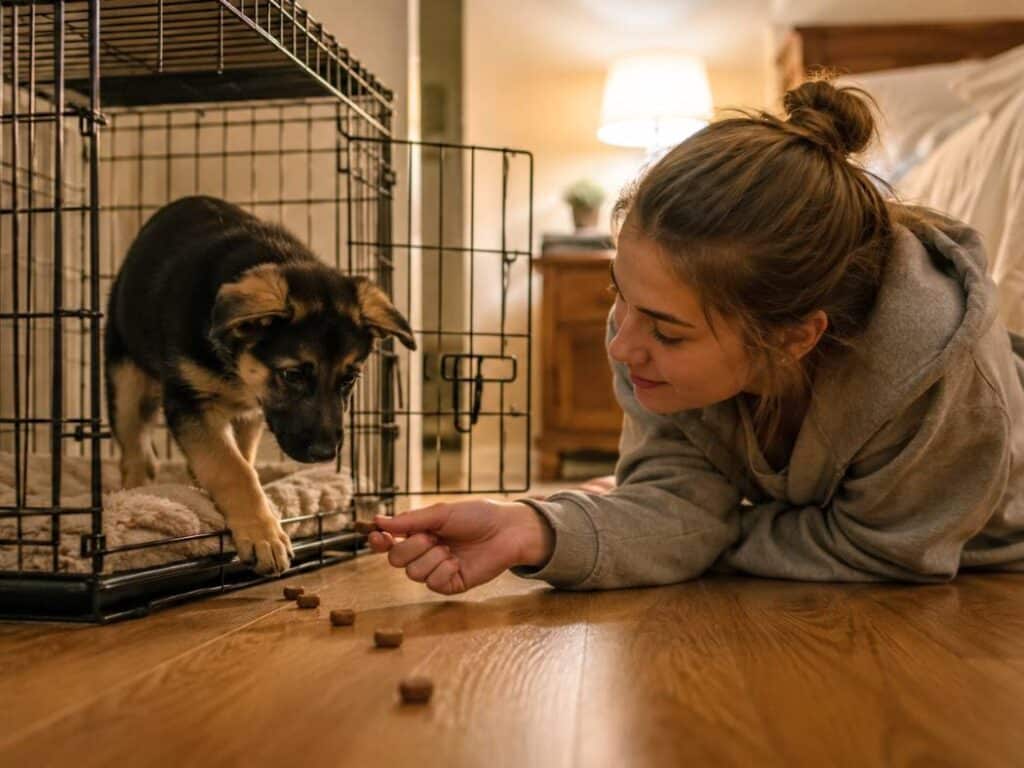
I understand this one deeply, because I felt the same way the first time. You bring home this puppy who has never been alone before, you hear him crying in the crate, and every instinct you have says let him out, this is wrong.
But here’s the reframe that changed everything for me: the crate is not a punishment. It’s a den. It’s the one place in your entire house that belongs entirely to your dog, where he is safe and cannot get into trouble, and where he can rest without stimulation. Dogs are den animals. A properly introduced crate becomes a place of genuine comfort — not confinement.
The owners who skip crate training because it seems unkind often end up with puppies who destroy the house, who can’t be left alone without anxiety, and who never develop the ability to self-settle. That’s not freedom. That’s a dog who is overwhelmed by too much space and too many choices.
Why it becomes costly: A German Shepherd who was never crate trained is incredibly difficult to manage during the inevitable moments of life when you need to confine him — vet visits, injury recovery, travel, guests who are afraid of dogs. It also leaves your home vulnerable during the destructive puppy and adolescent phase, and it makes separation anxiety far more likely, because the dog was never taught that being alone is safe and temporary.
What to do instead: Introduce the crate slowly and positively before you ever close the door. Put treats inside. Feed meals inside. Let your puppy wander in and out freely for a few days before you start closing it. When you do close it, start with very short periods while you’re in the room. Gradually increase the duration.
Expect some crying at first — that’s normal. Don’t open the door the moment he cries or you’ll teach him that crying = freedom. Wait for even a few seconds of quiet, then open the door. Build from there. Most German Shepherd puppies take to the crate within a week if it’s introduced properly and paired with good things.
The crate is a tool that gives your puppy safety and you peace of mind. Use it.
7. Using Punishment-Based Training Methods
German Shepherds are sensitive. I know that might surprise people who see this breed as tough, confident, and fearless — and they can be all of those things. But they are also deeply emotionally attuned to the humans they bond with, and they do not respond well to harsh correction, intimidation, or punishment-heavy training approaches.
The old-school “alpha” methods — scruff shaking, alpha rolls, leash pops, shock corrections for puppies — are not just outdated. With a German Shepherd, they’re genuinely counterproductive. A sensitive GSD who is regularly punished doesn’t learn to behave better. He learns that humans are unpredictable and threatening. That fear and confusion tends to come out as anxiety, shutting down, or, in some cases, defensiveness and aggression.
Why it becomes costly: Fear-based responses in German Shepherds can harden into deeply ingrained behavioral patterns that are very difficult to reverse. A dog who learned early on that corrections come without warning, that certain situations lead to pain or intimidation, may develop a reactive or defensive edge that no amount of positive training later can fully undo. You may also lose the trust of a dog who was willing to work with you, and rebuilding that trust takes far longer than building it right the first time.
What to do instead: Modern, positive reinforcement-based training works beautifully with German Shepherds. This breed is food-motivated, praise-motivated, and toy-motivated — often all three. They learn quickly when learning is rewarding. Mark the behaviors you want with a treat, a “yes,” or a clicker. Ignore or redirect behaviors you don’t want. Set up situations where your dog can succeed, and build from there.
This doesn’t mean you never set limits or that there are no consequences for behavior. Structure and leadership are still important. But there’s a world of difference between clear, calm boundaries and punishment. German Shepherds respond to calm, consistent leadership far better than they respond to force. I’ve seen dogs completely shut down under harsh methods — and those same dogs flourish with a patient, positive approach.
8. Waiting Too Long to Address Problem Behaviors
Here’s a scenario I’ve seen play out more times than I can count: a German Shepherd puppy starts doing something concerning — growling at food, barking at strangers on walks, guarding a favorite chair — and the owner decides to wait and see. Maybe it’s a phase. Maybe he’ll grow out of it. He’s still so young.
Weeks pass. The behavior continues. Now the owner is searching online, telling themselves it’s probably fine, not wanting to believe their puppy might have a real issue. By the time they seek help, the behavior is six months old and far more ingrained than it needed to be.
Early intervention is almost always faster, cheaper, and more effective than late intervention. Always.
Why it becomes costly: German Shepherds are not a breed where concerning behaviors typically self-resolve. They’re a breed where patterns, once established, tend to deepen over time. A puppy who growls over his food bowl at twelve weeks and is never corrected properly is much more likely to bite over resources at twelve months. A dog who barks and lunges at strangers on leash at five months, unchecked, becomes far harder to work with at eighteen months. The window when these issues are most addressable is early — and that window closes faster than you’d like.
What to do instead: Trust your instincts. If something your puppy is doing feels wrong, it probably warrants attention. This doesn’t mean panicking or labeling a twelve-week-old as dangerous. It means getting eyes on the situation from someone who knows German Shepherds.
Find a qualified trainer — someone who uses modern, positive methods and has specific experience with the breed — and consult them early. Don’t wait until the behavior becomes a crisis. A single session with a good trainer can give you a clear picture of what you’re dealing with and a concrete plan for addressing it. That clarity is worth far more than the cost of the session.
9. Neglecting the Bond and Relationship

This one is subtler than the others, but it might be the most important one of all.
German Shepherds are not dogs who do well as yard dogs, kenneled dogs, or dogs who spend most of their time alone while life happens around them. They are bonding dogs. They are partnership dogs. Every fiber of their breeding is oriented toward working closely with a human handler — reading them, responding to them, being part of a team.
When that bond isn’t developed, German Shepherds don’t just become independent. They become anxious, difficult, and often destructive. The breed-specific loyalty and responsiveness that makes them so extraordinary doesn’t happen automatically. It has to be built, every single day, through time, attention, training, and genuine connection.
I’ve known German Shepherds who were well-exercised, well-fed, and trained to a high level — but who clearly didn’t have a deep bond with their owners. And those dogs were noticeably less settled, less responsive, and less happy than dogs who had that relationship at the core of everything.
Why it becomes costly: A German Shepherd without a strong bond with his handler has no real motivation to listen, no framework for trust, and no emotional anchor during stressful situations. Training becomes harder. Recall is unreliable. The dog handles new situations poorly because he has no one he fully trusts to take his cues from. You end up working harder for less result because you’re trying to train a dog whose heart isn’t quite in it.
What to do instead: Spend time with your dog that isn’t about tasks or training. Take him with you when you can. Sit on the floor and just hang out. Go for walks where he gets to sniff and explore at his own pace. Learn what he loves and give him that. Talk to him. I know that sounds soft, but German Shepherds track your voice and your attention with remarkable sensitivity. Let him know he matters to you.
And then train together regularly — not because you need to fix something, but because training with a German Shepherd who trusts you is genuinely one of the most rewarding things you’ll ever do with a dog. That relationship is the foundation everything else is built on.
10. Not Preparing for the Adolescent Phase
You hear about puppy months. You don’t hear enough about the adolescent phase — and with German Shepherds, this is often where new owners feel completely blindsided.
Somewhere between six and eighteen months, your well-started puppy might start doing things that make you feel like you’re back at square one. He suddenly “forgets” commands he knew cold. She’s pushier, more independent, more easily distracted. The impulse control you worked hard to build seems to evaporate. He starts challenging boundaries he accepted without question at four months.
Welcome to German Shepherd adolescence. It’s real, it’s challenging, and it catches a lot of owners off guard.
Why it becomes costly: Owners who don’t understand the adolescent phase tend to interpret it as a failure — either the training didn’t work or the dog is “dominant” or “untrainable.” Some give up and stop training entirely, which is exactly the wrong response. Others start relying on physical control or management only, which means the dog never actually develops the self-regulation he needs. By the time the adolescent phase ends around 18 to 24 months, those dogs have often drifted considerably from where they were at five months.
What to do instead: Understand that this is neurological, not personal. During adolescence, the GSD brain is going through significant development — the same processes that make human teenagers seem irrational and impulsive. Your dog is not being stubborn. He is genuinely less capable of self-regulation than he was at four months, and less than he will be at two years. This is temporary.
Your job during this phase is to hold the line without escalating. Keep training. Stay consistent. Reduce the off-leash freedom and increase structure. Don’t give your adolescent German Shepherd unlimited freedom to make poor choices, but don’t punish him for being developmentally normal either. This phase will pass — and a dog who was handled well through it comes out the other side as a remarkably solid, reliable adult.
I always tell new German Shepherd owners to expect the adolescent phase to test everything they’ve built, and to decide in advance that they’re going to keep going anyway. That decision matters more than almost anything else you’ll do.
Wrapping Up: The Dogs They Become Are Built Right Now
Here’s the thing I want to leave you with: German Shepherd puppies are not difficult. They’re demanding — and there’s a difference.
Difficult means the deck is stacked against you. Demanding means this dog requires real investment, real attention, real consistency. And the return on that investment is extraordinary. A well-raised German Shepherd is loyal, intelligent, deeply connected, capable of almost anything, and one of the most rewarding companions you’ll ever have.
Every mistake on this list is also a reminder of how much these dogs need from us — and how capable they are of rising to meet us when we give them what they need. Structure. Leadership. Socialization. Bond. Exercise. Early training. Patience through the hard phases.
You don’t have to be perfect. You have to be consistent, thoughtful, and willing to keep learning. German Shepherds are forgiving of mistakes made from love — and they notice the effort you’re making, even when the results aren’t there yet.
Start now. Start today. The puppy in front of you is paying close attention to everything you do, and he’s already forming the patterns that will define who he becomes.
Make them good ones.
Have questions about German Shepherd puppy training, socialization, or behavior? Drop them in the comments — I read every one.